Top 10 Preschool Classroom Seating Options for Schools
Choosing the right Preschool Classroom Seating is not a decoration exercise. It shapes movement, attention, cooperation, and children’s sense of belonging. A low table, soft floor cushion, or child-sized chair can change how a four-year-old joins a story, reaches for materials, or settles after active play.
Research supports careful choices. The OECD’s Starting Strong V report links high-quality early-learning environments with children’s development and meaningful interactions. NAEYC’s Developmentally Appropriate Practice statement also recommends accessible, flexible spaces that respond to children’s individual needs. UNICEF’s Early Childhood Development reports stress that young children need safe, stimulating environments, not simply more furniture. These findings give schools a reliable starting point, although they do not provide one universal seating formula.
Loris Malaguzzi, the influential Reggio Emilia educator, famously said, “The environment is the third teacher.” His insight remains practical: seating silently teaches children where to gather, how to share, and when to move. The ten options in this guide examine stools, wobble seats, floor cushions, benches, activity chairs, and flexible tables through safety, comfort, durability, cleaning, and classroom flow.
Small details matter. Rounded edges reduce worry. Open storage improves access. Lightweight seats support quick transitions. Still, no arrangement works perfectly for every child. A busy classroom may need quieter corners, while a compact room may sacrifice visual appeal for safer movement. Schools should test each option during real routines, observe children closely, and revise the layout when evidence disagrees with first impressions. That reflective process makes Preschool Classroom Seating more useful, inclusive, and dependable.
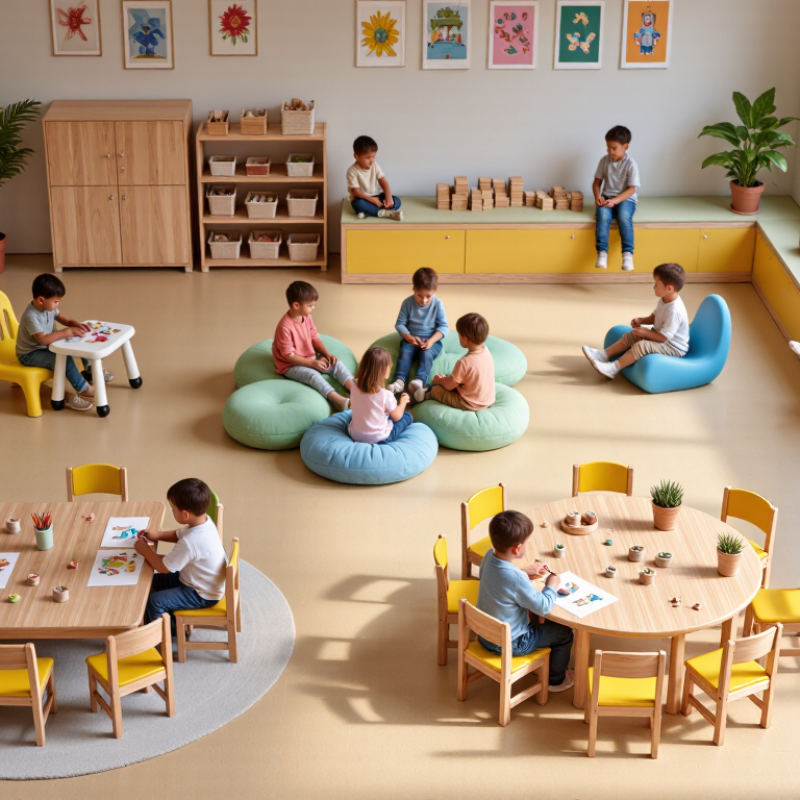
How to Evaluate Preschool Classroom Seating for Safety and Learning
Top 10 Preschool Classroom Seating Options for Schools
Choosing preschool seating requires more than comparing colors, prices, or shapes. Educators should inspect ten practical options: child-sized chairs, stools, floor cushions, low benches, wobble seats, stackable chairs, activity tables, carpet spots, soft blocks, and adjustable tables. Each option should match children’s height, movement needs, and classroom routines. A child’s feet should rest comfortably, and knees should bend naturally. Sharp corners, loose parts, unstable legs, and slippery surfaces deserve immediate attention. Test every seat on the actual classroom floor.
Safety comes before appearance. Check weight limits, cleanable surfaces, rounded edges, and resistance to tipping. Materials should be durable and suitable for frequent cleaning. Teachers should also consider clear walking paths, emergency movement, and accessible seating for children with different physical needs. During observation, watch whether children rock dangerously, lean across tables, or struggle to stand. These behaviors may signal poor design rather than poor discipline. No checklist catches every problem.
Learning needs equal attention. Seating should support eye contact, group discussion, independent work, and quiet concentration. Lightweight pieces can create quick areas for reading, building, or sensory activities. However, too much flexibility may produce noise and distraction. I would test one arrangement for several days, record interruptions, and ask children how their bodies feel. A beautiful setup can still fail. Review it honestly. Replace pieces that invite unsafe play, even when they look attractive or cost more.
Chair-and-Table Seating Options for Preschool Classrooms
Top 10 Preschool Classroom Seating Options for Schools
Chair-and-table seating should support movement, comfort, and safe participation. Preschool rooms often benefit from varied layouts rather than one fixed arrangement. Individual chairs with small tables give children personal workspaces and clear boundaries. Shared rectangular tables encourage drawing, puzzles, and cooperative projects. Round tables make conversation easier because every child can see the group. Kidney-shaped tables help teachers provide closer support during guided activities.
Adjustable-height tables can serve children of different sizes, although the adjustment system must be secure. Stackable chairs save storage space after messy play. Lightweight chairs allow supervised classroom changes. Benches fit more children, but they may offer less personal space. Floor-level tables support block building and sensory activities. A table with rounded edges can reduce minor bumps during busy transitions. Choose stable furniture with smooth surfaces, suitable seat heights, and enough legroom. Check weight limits and local safety guidance before purchasing. Small details matter.
Tips: Measure walking paths before arranging furniture. Leave clear routes between tables and shelves. Test each chair for tipping, pinched fingers, and sharp edges. Wipe surfaces daily, especially after snacks or paint. Watch how children actually use the room. A beautiful layout may still create crowding. Some children need more space than expected, and one seating plan will not suit everyone. Rotate options carefully, then record which arrangements improve focus, sharing, and independent movement.
Flexible and Active Seating Choices for Young Learners
Top 10 Preschool Classroom Seating Options for Schools
Flexible and Active Seating Choices for Young Learners
A preschool classroom should offer more than fixed chairs and matching tables. Ten practical options include low tables, child-sized chairs, floor cushions, carpet spots, benches, wobble stools, rocking seats, balance cushions, standing tables, and soft reading loungers. Each option supports a different posture and activity. A child might kneel at a low table, rock gently during story time, or stand while sorting colored blocks. Movement becomes part of learning.
The World Health Organization’s 2019 guidelines recommend at least 180 minutes of daily physical activity for children aged three and four. At least 60 minutes should reach moderate-to-vigorous intensity.
Flexible seating cannot replace outdoor play, but it can reduce long, rigid sitting periods. NAEYC’s developmentally appropriate practice guidance also supports environments that reflect children’s movement, choice, and comfort.
In practice, teachers should observe whether a wobble stool improves focus or simply creates distraction. Sometimes, it does both.
Tips: Start with two active seating choices, not ten at once. Keep pathways wide and floors clear. Use stable furniture with rounded edges and non-slip bases. Match seats to children’s height, feet, and balance needs. Invite children to choose, then teach them how to return each item safely. Track participation for one week. The results may challenge your first plan.
How Schools Can Select, Arrange, and Maintain Seating Options
Top 10 Preschool Classroom Seating Options for Schools
How Schools Can Select, Arrange, and Maintain Seating Options
Preschool seating should support movement, independence, and safe social interaction. Consider low chairs, small tables, benches, floor cushions, stools, wobble seats, soft mats, reading nests, standing stations, and flexible activity tables. Choose rounded edges, stable bases, washable surfaces, and sizes that let children place both feet comfortably. The World Health Organization recommends at least 180 minutes of daily physical activity for children aged three to four, including 60 minutes of moderate-to-vigorous movement (WHO, 2019). Fixed seating may quietly reduce those opportunities.
Tips: Measure children, not only furniture. Keep clear routes between tables. Place quiet seating away from block play. Leave one adaptable space for children who need more movement or personal distance. NAEYC’s Developmentally Appropriate Practice guidance supports accessible, flexible learning environments, but it does not prescribe one seating layout. That matters. A perfect arrangement is unrealistic.
Observe the room during arrival, meals, and group time. If children twist, kneel on chairs, or carry seats repeatedly, revise the setup. Store lightweight furniture at child height, while anchoring tall storage units securely. Inspect screws, glides, seams, and cushions weekly. The U.S. Consumer Product Safety Commission identifies stability, sharp edges, and entrapment points as important child-product hazards. Keep a simple inspection log with dates and actions. Cleaning plans also need revision; shared cushions can require more frequent sanitation than hard plastic chairs.
Top 10 Preschool Classroom Seating Options for Schools
Typical planning footprint per child seat, based on common preschool furniture dimensions. Lower values support more flexible classroom layouts, while larger values may provide greater comfort or stability.
Schools should combine compact seating with clear circulation paths, accessible spaces, safe storage, and regular inspections for loose parts, sharp edges, damaged surfaces, and unstable bases. Actual dimensions vary by age group and furniture specification.
 Skip to content