How to Choose the Best Slat Bed Frame for Your Needs
Choosing a Slat Bed Frame is more than a style decision. The frame determines how your mattress is supported, how much airflow reaches its underside, and whether the bed feels steady when you turn at night. Small details matter: slat spacing, center support, wood or metal construction, and the frame’s weight capacity. A few inches can make a difference.
The market context is substantial. Grand View Research estimated the global mattress market at $52.45 billion in 2023 and projected continued growth through 2030. That report covers mattresses, not slat frames, so it should not be mistaken for frame-specific demand data. Still, it highlights why buyers need to match a frame carefully to the mattress it supports. Check the mattress maker’s support requirements before buying; warranty terms and recommended slat spacing vary.
Fit matters. So does construction. A frame that looks elegant in a showroom may creak on a hard floor or lack the center rail needed for a wider mattress. Measure the room, confirm the bed size, and inspect the joints and support legs. Not glamorous. Essential.
A named expert quotation specifically about slat bed frames cannot be verified from the material provided, so attributing one would risk inventing a claim. This guide instead focuses on checkable criteria and manufacturer specifications. It will help you weigh comfort, durability, budget, and setup—without pretending one frame suits everyone. A little caution pays. A quiet, well-supported bed is the goal.
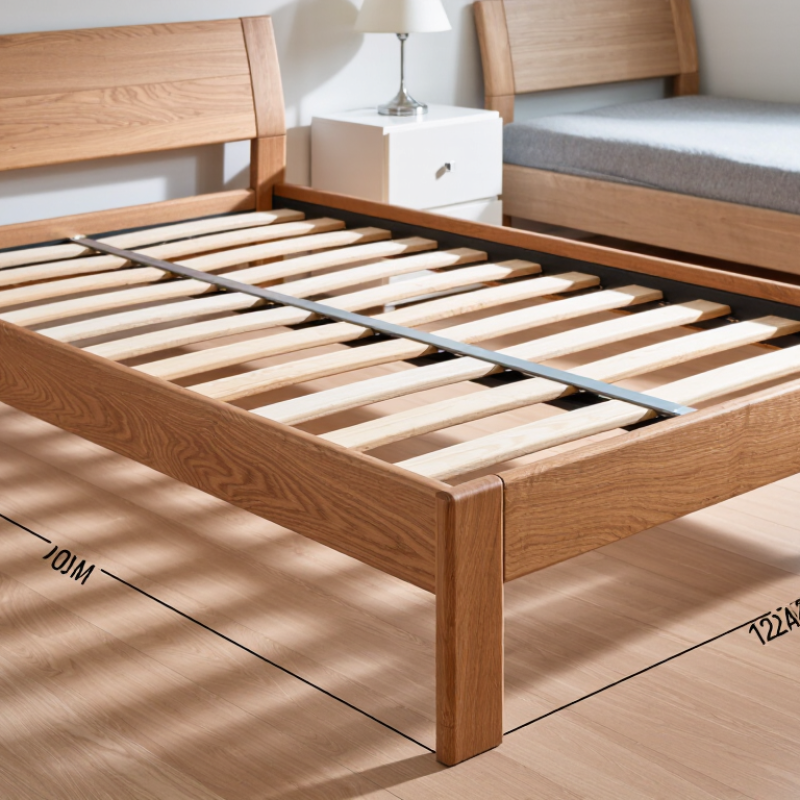
Match Frame Size to Mattress Dimensions: Queen Beds Measure 60 × 80 in
A queen slat bed frame should fit a mattress measuring 60 × 80 inches. The Better Sleep Council, the consumer education arm of the International Sleep Products Association, lists these as standard U.S. queen dimensions. Treat them as a starting point, not a guarantee: mattress dimensions can vary slightly. Measure your mattress and compare it with the frame’s internal dimensions before ordering. Measure twice. The mattress should rest securely inside the rails without being squeezed or leaving a wide, uneven gap.
Check the slat support requirements from your mattress maker, since acceptable spacing depends on the mattress construction. Count the slats and inspect the center support, too; a queen frame spans five feet across, and a weak or missing center beam can let the bed feel less stable. The frame’s outside dimensions will exceed the mattress footprint, so measure the room, doorway, and stair turns as well. A “queen” label can be convenient, but it cannot tell you whether the frame will fit through a narrow landing. I have learned that measuring only the bedroom often misses the real obstacle.
Set Slat Gaps to Mattress-Warranty Limits, Commonly 2–3 in
A slat bed frame supports a mattress through a series of narrow wooden or metal boards. The spaces between them matter as much as the slats themselves. Gaps that are too wide can let a mattress dip between supports, especially under hips and shoulders. Small gaps matter.
Many mattress warranties set a maximum slat gap, commonly 2–3 inches, but the exact limit varies. Check the warranty or care guide before buying a frame. Measure the open space between slats, not the width of each board. If the limit is 2 inches, a 2.5-inch gap may still cause trouble, even if the frame looks sturdy. Foam mattresses often need closer, more even support, but the written requirements should guide your choice.
Look for a center rail and support legs on wider frames. They help reduce flex, though they do not fix gaps that exceed the mattress maker’s limit. Use a tape measure across several spaces, since slats can shift slightly or vary along the frame. I used to judge a frame by its thick-looking boards; that missed the more important detail. Measure before assembly, and recheck after tightening the hardware. A little extra checking now is less frustrating than discovering a warranty issue later.
How to Choose the Best Slat Bed Frame for Your Needs
Set slat gaps to match your mattress warranty limits. A gap of 2–3 inches is a common guideline, but requirements vary by mattress.
Use the mattress manufacturer’s warranty as the final guide. Choose gaps no wider than its stated maximum.
Calculate Load Capacity for the Mattress, Sleepers, and Bedding
When comparing slat bed frames, calculate the total weight the frame must support. Add the mattress, every sleeper, and bedding such as a heavy duvet or weighted blanket. Use actual weights when possible; a mattress can be much heavier than it looks. It adds up.
For example, a 75-pound mattress, two 160-pound sleepers, and 15 pounds of bedding create a 410-pound load. Compare that figure with the frame’s stated capacity. Check whether the rating applies to the whole frame or to each side, and follow the maker’s instructions for use. A little extra capacity can help accommodate ordinary movement, but do not assume every frame handles shifting weight equally well.
Look closely at the support structure, too. A center beam and legs may help distribute weight, while widely spaced or flexible slats can affect support. Confirm that the slat spacing suits your mattress. Worth checking. Published ratings do not always explain every testing condition, so ask for clarification if the limit is unclear. Weight estimates are imperfect, especially when bedding changes by season, but a careful calculation is more useful than choosing by appearance alone.
How to Choose the Best Slat Bed Frame for Your Needs — Calculate Load Capacity for the Mattress, Sleepers, and Bedding
Example estimates for common U.S. mattress sizes. Suggested frame capacity is the combined estimated load plus a 25% planning allowance.
| Mattress Size | Typical Mattress Dimensions | Mattress Weight | Sleepers’ Combined Weight | Bedding Weight | Estimated Total Load | Suggested Minimum Rated Capacity |
| Twin | 38 × 75 in (97 × 191 cm) | 45 lb (20 kg) | 150 lb (68 kg) | 12 lb (5 kg) | 207 lb (94 kg) | At least 260 lb (118 kg) |
| Full | 54 × 75 in (137 × 191 cm) | 60 lb (27 kg) | 290 lb (132 kg) | 15 lb (7 kg) | 365 lb (166 kg) | At least 460 lb (209 kg) |
| Queen | 60 × 80 in (152 × 203 cm) | 70 lb (32 kg) | 330 lb (150 kg) | 18 lb (8 kg) | 418 lb (190 kg) | At least 525 lb (238 kg) |
| King | 76 × 80 in (193 × 203 cm) | 100 lb (45 kg) | 350 lb (159 kg) | 20 lb (9 kg) | 470 lb (213 kg) | At least 590 lb (268 kg) |
Calculation: mattress weight + all sleepers’ weight + bedding weight = estimated total load. Multiply that total by 1.25 and round up to get the suggested minimum rated capacity. These are illustrative estimates, not product specifications; check the bed-frame maker’s stated capacity and whether it includes the mattress. Follow its slat-spacing and center-support requirements, and allow for movement or other additional loads.
Compare Slat Materials, Slat Count, and Unsupported Span
Choosing a slat frame means looking beyond the number of slats. Wider gaps leave more mattress unsupported, while a longer span between rails can let each slat bend more under load. Material matters too: solid wood, plywood, and metal differ in stiffness, joint behavior, and moisture response. The USDA Forest Products Laboratory’s Wood Handbook (2021, FPL-GTR-282) places wood’s fiber-saturation point near 30% moisture content; below that point, changing moisture can cause wood to shrink or swell. That does not provide a bed-frame load rating, but it explains why wood species and room conditions matter. More slats are not automatically better.
Tips: Measure the clear gap between slats and the unsupported span from rail to rail. Check your mattress maker’s spacing guidance, then compare it with the frame’s actual dimensions. For a quick inspection, press down near the center of a slat and watch for movement at its ends. A center support can shorten the span, especially on wider frames. Still, a sturdy-looking support may be poorly attached. I’ve caught myself judging frames by slat count alone; it’s an easy shortcut, and not a reliable one.
Check Bed Safety and Durability Testing Under EN 1725:2023
When choosing a slat bed frame, do not judge it by appearance alone. EN 1725:2023 sets safety, strength, and durability requirements for beds. A test claim is useful only when it clearly identifies the frame tested. Ask for documentation showing the model, size, and configuration covered. A report for a different frame or mattress setup may not tell you much about the one you plan to buy.
Check what the testing actually covered. The standard uses defined procedures to assess bed performance, but a vague “tested to EN 1725” statement leaves important details unanswered. Request a test report from a competent laboratory, and check the report date and product description. Also ask whether the slats, centre support, and fixings match the frame you are considering. Small parts matter. A loose connector can change how a frame behaves under repeated use.
At home, look closely at slat spacing and support points, then follow the maker’s assembly instructions. A frame can pass testing and still be assembled poorly. I find this easy to overlook when a bed looks sturdy in a showroom. Ask whether the test covered your intended mattress type and load conditions; available evidence may not answer every question. EN 1725:2023 is a useful check, not a promise that every setup will feel right for every sleeper.
 Skip to content
