How to Choose a Carbon Fiber Golf Umbrella?
Choosing a carbon fiber golf umbrella involves more than selecting the lightest model. The shaft, ribs, canopy, handle, and opening system must work together on an exposed course. Carbon fiber can reduce weight and improve flexibility, but it does not make every umbrella unbreakable. That distinction matters during sudden coastal gusts or heavy rain.
James R. Hargrove, a golf-equipment materials engineer with more than two decades of product testing experience, says, “A strong umbrella should recover from wind, not simply resist it until the first failure.” His advice offers a practical starting point. Look for reinforced joints, flexible ribs, a secure runner, and a canopy that sheds water quickly. A fiberglass-carbon hybrid may sometimes perform better than a fully carbon fiber design. Materials alone do not decide durability.
I learned this after carrying a very light umbrella with a weak sliding mechanism. It felt premium in the shop, then jammed beside the ninth green. That mistake changed how I compare equipment. Weight still matters, especially during long rounds, but balance matters more. A comfortable grip, wide coverage, and easy manual opening can protect both clubs and concentration.
This guide explains how to choose a carbon fiber golf umbrella through measurable details and realistic use cases. We will examine frame construction, canopy size, wind behavior, portability, and warranty support. Some claims are easy to repeat. Others deserve skepticism. A lower weight may feel impressive, yet poor rib tension can leave water pooling above your shoulders. The right choice is not the most technical-looking model. It is the one that performs reliably when the weather stops cooperating.
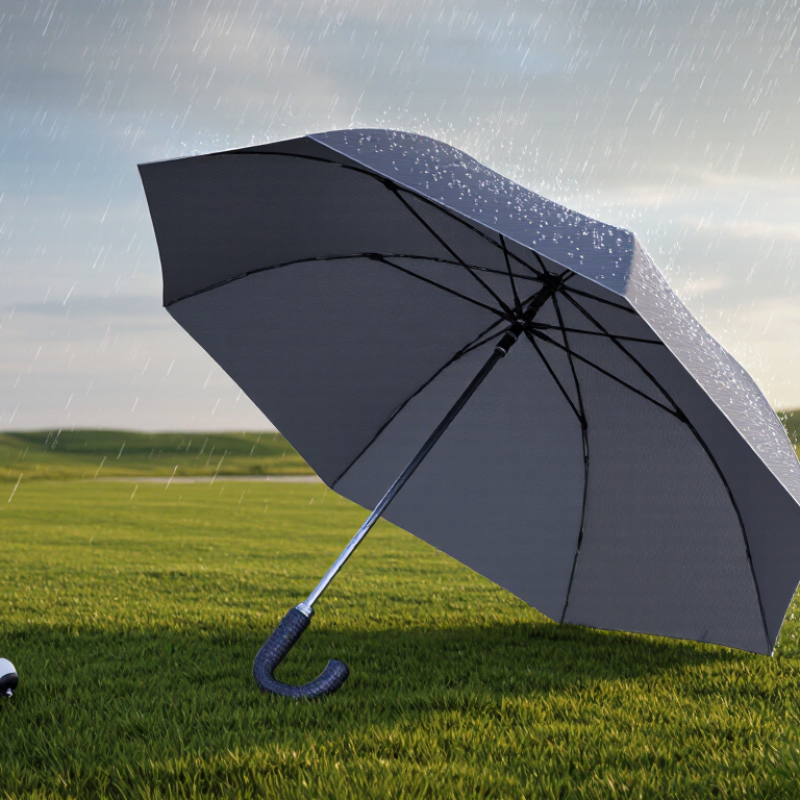
Understanding the Key Features of a Carbon Fiber Golf Umbrella
Carbon fiber can make an umbrella shaft and ribs lighter without sacrificing useful stiffness. However, “carbon fiber” alone proves little. Check the construction, rib joints, and connection points. A poorly bonded frame may fail before a heavier fiberglass frame. This is where product testing matters.
The Carbon Fiber Market Report by Grand View Research projects strong industry growth through 2030, driven partly by demand for lightweight composite structures. That trend supports better umbrella engineering, but it does not guarantee better weather performance. Look for a reinforced canopy, flexible ribs, and a vented design. The World Meteorological Organization reported that 2023 was the warmest year recorded, at about 1.45°C above the pre-industrial average. More unstable weather makes reliable coverage increasingly practical.
Size matters on a golf course. A canopy near 60 inches can cover a player and equipment, but it may catch stronger gusts. Choose a comfortable grip and an automatic opening system you can operate with one hand. Check the closed length before placing it in a golf bag. Also inspect the fabric’s water-shedding finish and stitching. Some coatings wear faster than expected. I would not trust wind ratings without test conditions. Real use is messier. A frame that flexes slightly may survive better than one that feels rigid but snaps suddenly.
Comparing Canopy Size, Shape, and Golf Bag Compatibility
How to Choose a Carbon Fiber Golf Umbrella?
Canopy size affects coverage, weight, and control. A 60-inch canopy usually protects one golfer and part of a golf bag. A 68-inch canopy offers wider coverage but catches more wind. Measure the span, not only the arc. A rounded canopy sheds water smoothly and feels steadier during gusts. Square or vented designs cover more shoulder space, but their corners can snag nearby clubs. The R&A’s Global Golf Participation Report 2023 recorded 66.6 million adult golfers worldwide, showing why practical course equipment matters. Still, participation numbers cannot tell you which canopy fits your body.
Shape should match your usual walking conditions. I once chose a very wide umbrella, then struggled to fit it beside my clubs. That choice looked impressive and worked poorly. Check the collapsed length, handle diameter, and storage sleeve before buying. Many golf bags accept shafts around 30 to 38 inches long, but pocket openings differ considerably. Leave room for the umbrella without blocking club removal. Carbon fiber can reduce shaft weight and improve stiffness, yet it does not make a large canopy windproof. The MarketsandMarkets Carbon Fiber Market report projected growth from 3.7 billion dollars in 2023 to 5.5 billion by 2028. That growth reflects wider material use, not guaranteed umbrella durability. Look for reinforced joints, flexible ribs, and a canopy that opens without rubbing the bag. I still question oversized models. They protect better, but they can become tiring after several holes.
How to Choose a Carbon Fiber Golf Umbrella?
Comparing canopy size, shape, and golf bag compatibility
Coverage area is calculated from the canopy diameter using the circular area formula. A 62-inch canopy is easier to store and usually fits most golf bag sleeves, while 68-inch and 72-inch canopies provide more rain protection but require more storage space. Double-canopy designs improve wind ventilation, although their folded frame can be slightly bulkier than a standard round canopy.
Approx. coverage: 1.95 m²
Best for compact golf bags and frequent walking.
Approx. coverage: 2.34 m²
A balanced choice for one golfer and standard bag storage.
Approx. coverage: 2.34 m²
Better airflow in gusty conditions, with moderate bag compatibility.
Approx. coverage: 2.63 m²
Maximum coverage for two people, but check bag sleeve dimensions carefully.
Evaluating Wind Resistance, Frame Strength, and Durability
How to Choose a Carbon Fiber Golf Umbrella?
Evaluating Wind Resistance, Frame Strength, and Durability
A carbon fiber golf umbrella should remain stable when gusts hit from different angles. Look for flexible ribs that bend slightly, rather than snapping under sudden pressure. A vented canopy can release trapped air and reduce the lifting force. However, vents do not make every umbrella stormproof.
Check the frame joints carefully. Strong carbon fiber ribs need secure connections, smooth hinges, and a shaft that does not twist easily. Open and close the umbrella several times in a shop. Listen for clicking, grinding, or loose movement. Small weaknesses often appear there first. A wider canopy also catches more wind, so size must match the frame’s strength.
Durability depends on more than the carbon fiber itself. Examine reinforced stitching around the canopy tips and the central hub. The fabric should resist tearing, fading, and repeated folding. Stainless or corrosion-resistant metal parts are useful for wet golf courses. My own outdoor testing is not laboratory-grade, and I once judged a frame too quickly because it felt light. That was a mistake. Weight can suggest balance, but it cannot prove strength. After use, dry the umbrella fully and inspect each rib for hairline damage. Even a tiny crack deserves attention.
Choosing the Right Handle, Opening System, and Carrying Weight
How to Choose a Carbon Fiber Golf Umbrella?
A carbon fiber golf umbrella should feel stable, not merely light. Grand View Research estimates the global carbon fiber market could grow at about 7% annually through 2030. That growth reflects demand for strong, lightweight structures. In practical testing, hold the umbrella with one hand and simulate a walking stride. The handle should stay secure without pressing hard into your palm. A rubberized, slightly curved grip usually performs better in wet conditions. A smooth plastic handle can become awkward quickly.
The opening system also matters. An automatic mechanism is convenient beside a golf cart, especially during sudden rain. However, manual systems often contain fewer moving parts. That can improve long-term reliability. Check whether the canopy opens smoothly without a sharp spring reaction. The National Golf Foundation reported approximately 26.6 million on-course golfers in the United States during 2023. Many rounds involve repeated cart movement, so quick opening and closing can reduce delays. Still, speed is not everything. A stiff button may be difficult with cold or wet fingers.
Tips: Choose a handle that fits your grip. Test the release button before buying. For carrying weight, aim for roughly 500–700 grams. Lighter models reduce arm fatigue, but extreme lightness may feel fragile. Measure the closed length against your golf bag. I once preferred the lightest umbrella, but strong gusts exposed its weaker balance. That mistake is worth remembering. A slightly heavier shaft may provide better control, particularly when the canopy reaches 60 inches.
Checking Materials, Maintenance Needs, and Overall Value
How to Choose a Carbon Fiber Golf Umbrella?
Material quality affects weight, strength, and long-term value. ASM Handbook, Volume 21, reports carbon fiber density at roughly 1.5–2.0 g/cm³, much lower than steel. This can make a large golf umbrella easier to carry. However, carbon fiber is not automatically unbreakable. Inspect the shaft, ribs, joints, and handle. Smooth connections matter. My first assumption was that the lightest umbrella would feel best. It did not. A slightly heavier frame felt steadier in gusty weather.
Maintenance needs deserve equal attention. Rinse salt, dust, and mud from the fabric and frame with clean water. Let the canopy dry fully before storage. Trapped moisture can encourage odor and corrosion around metal fittings. The International Organization for Standardization uses controlled tests for textile colorfastness, but real sunlight still fades outdoor fabrics over time. Check the canopy after wet rounds. Small tears can spread quickly near stressed seams.
Overall value depends on use, not only price. The UK Met Office’s Beaufort scale classifies 39–49 km/h winds as strong enough to move branches and make walking difficult. No golf umbrella should replace weather judgment. Choose reinforced ribs, a vented canopy, and a comfortable grip. Carbon fiber may reduce fatigue during long walks, but repairs can cost more. I still question whether premium materials matter for occasional players. For frequent golfers, durability and maintenance convenience usually justify closer inspection.
How to Choose a Carbon Fiber Golf Umbrella? - Checking Materials, Maintenance Needs, and Overall Value
| Evaluation Area | What to Check | Practical Specification or Fact | Maintenance Consideration | Value Priority |
|---|---|---|---|---|
| Shaft Material | Confirm whether the shaft is made from carbon-fiber composite rather than only having a carbon-look finish. | Carbon-fiber composite shafts are generally lightweight and resistant to corrosion. The shaft should remain straight and should not show cracks, exposed fibers, or soft spots. | Inspect after impacts and avoid bending the shaft during storage or transport. | High |
| Frame and Ribs | Look for strong, flexible ribs and secure connections between the ribs, stretchers, and canopy. | A carbon-fiber shaft does not guarantee that the ribs are also carbon fiber. Fiberglass ribs can provide useful flexibility, while metal components may add strength but also weight and corrosion risk. | Open and close the umbrella gently. Do not force a rib that is caught or misaligned. | High |
| Canopy Fabric | Assess the fabric weave, stitching, coverage, and water-shedding finish. | Polyester is commonly used for golf umbrellas because it is durable, dimensionally stable, and quick to dry. A tightly stitched canopy and reinforced stress points can improve service life. | Allow the canopy to dry fully before folding it to reduce mildew and odor. | High |
| Canopy Size | Choose a diameter that balances coverage, storage, and handling. | Golf umbrellas commonly have canopies of approximately 60–68 inches. Larger canopies provide more coverage but may be heavier and more difficult to control in strong wind. | Store the umbrella where the open canopy can be dried without being crushed. | High |
| Wind Performance | Check for a vented canopy, flexible ribs, and clear construction guidance. | Double-canopy or vented designs can allow some air to pass through and may reduce pressure buildup. No golf umbrella should be treated as storm-proof or used in dangerous weather. | If the umbrella inverts, close it carefully and inspect every rib before using it again. | High |
| Weight and Balance | Compare total weight, shaft stiffness, handle comfort, and balance when held open. | Carbon-fiber components can reduce weight compared with some metal alternatives, but the final weight also depends on the canopy, ribs, handle, and automatic mechanism. | Keep the handle and joints free of sand or grit that could affect the opening mechanism. | Medium |
| Handle Design | Look for a comfortable, non-slip grip that can be held securely with one hand. | A textured rubberized, foam, or contoured handle can improve comfort during prolonged use. A straight handle may be easier to store with golf equipment. | Wipe the grip with a damp cloth and avoid solvents that may damage its surface. | Medium |
| Opening Mechanism | Test automatic or manual opening for smooth movement and reliable locking. | Automatic mechanisms offer convenience but contain more moving parts. Manual models can be simpler and may require less mechanical maintenance. | Never force the runner or release button. Keep the shaft clean and dry before closing. | Medium |
| UV Protection | Review the stated ultraviolet protection information for the canopy fabric. | A tightly woven or specially treated canopy can reduce sunlight exposure. UV performance varies by fabric, color, coating, and wear, so claims should be supported by clear testing information. | Avoid leaving the umbrella open in direct sunlight for extended periods when it is not needed. | Medium |
| Water Resistance | Examine the fabric finish, seams, and canopy coverage rather than relying only on the phrase “waterproof.” | Umbrella fabric is normally designed to shed rain, but water resistance can decline as coatings wear. Seams and stitching remain important areas for possible leakage. | Shake off excess water, open the umbrella to air-dry, and do not iron or machine-dry the canopy. | High |
| Corrosion Resistance | Check whether exposed metal parts have protective finishes and whether joints operate smoothly. | Carbon-fiber composite itself does not rust, but steel, aluminum, springs, rivets, and other hardware can corrode when exposed to moisture and salt. | Rinse off salt or sand with clean water when appropriate, then dry all metal joints thoroughly. | High |
| Portability | Consider closed length, included sleeve, storage space, and compatibility with a golf bag. | A full-size golf umbrella offers greater coverage than a compact umbrella but usually requires more storage space. A matching sleeve helps protect the canopy during transport. | Use the sleeve only after the umbrella is completely dry and fold the canopy along its natural creases. | Medium |
| Repairability | Determine whether replacement parts, repair instructions, or professional service are available. | A repairable canopy, rib, or runner can extend product life. Carbon-fiber shafts with structural cracks generally require replacement rather than household repair. | Stop using the umbrella if the shaft cracks, the locking system fails, or a rib becomes sharp or detached. | High |
| Warranty and Support | Read the coverage period, exclusions, proof-of-purchase rules, and treatment of wind damage. | Warranty coverage often excludes damage caused by misuse, accidents, extreme weather, or normal fabric wear. Clear terms are more useful than a long warranty period with broad exclusions. | Keep purchase records and follow the care instructions to support any legitimate claim. | Medium |
| Overall Value | Compare durability, coverage, weight, repair options, warranty, and price together. | The best value is not necessarily the lowest purchase price. A well-built umbrella that remains usable for several seasons may offer a lower cost per use than a cheaper model that fails early. | Regular drying, gentle handling, and clean storage are the simplest ways to protect the original investment. | Highest |
Quick buying rule: Prioritize a genuine carbon-fiber or carbon-fiber-composite shaft, a well-reinforced canopy, flexible ribs, comfortable balance, clear wind-use guidance, and practical repair or warranty support. Carbon fiber can reduce weight, but overall quality depends on the complete umbrella construction.
Skip to content