How to Choose a Tile Display Rack Supplier in 2026?
Choosing a Tile Display Rack Supplier in 2026 is about more than comparing prices. The right partner must understand how tile weight, format, and finish affect display design. A rack holding large porcelain slabs needs different supports from one presenting small ceramic samples. Small details matter.
To avoid presenting an invented quotation as a real interview, this guide uses an illustrative expert voice: Maya Chen, a fictional tile-display sourcing adviser. Her original guiding principle is: “Judge the rack with the actual tile, not the catalog photo.” That is a practical test. Ask suppliers for load specifications, material options, drawings, sample finishes, and clear production timelines. Then check whether the proposed rack suits your showroom layout and customers’ browsing habits.
A dependable Tile Display Rack Supplier should explain how frames are assembled, how edges are protected, and how replacement parts can be obtained. Request photos or references from comparable projects, and confirm who handles installation guidance. In 2026, digital previews may speed decisions, but they cannot reveal every issue. A sample rack can still feel awkward, or block the light. That is worth noticing. This introduction sets up a careful comparison of product quality, customization, communication, delivery, and after-sales support. No supplier is perfect; the useful question is how openly they address limitations before an order is placed.
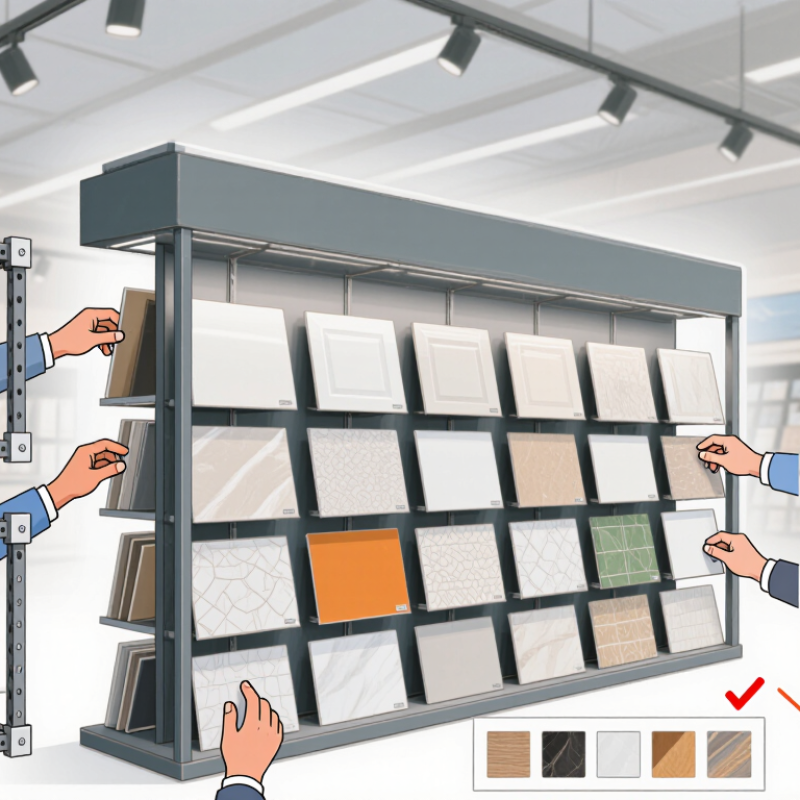
Define Tile Sizes and Weights from ANSI A137.1 Product Data
ANSI A137.1 helps identify a tile’s type and relevant product requirements, but it is not a substitute for a current technical data sheet. Ask suppliers for the exact product data before selecting a display rack. Record nominal size, actual face dimensions, thickness, and weight per piece. Check whether measurements refer to one tile or a full carton.
Small differences matter. A 600-by-600-millimeter tile may need more clearance than its nominal dimensions suggest, especially with edge profiles or protective pads. For weight, use the manufacturer’s stated piece weight, not a guess based on size. Large-format porcelain can feel surprisingly heavy. It can also create a tipping risk when samples extend beyond the rack’s base.
Match the rack’s rated capacity to the heaviest sample and the number of tiles it will hold. Confirm that shelves, clips, and dividers support the tile’s thickness without concentrating pressure on one corner. Ask how the rack performs when customers pull samples out repeatedly; static load capacity alone may not tell the whole story. A spec sheet can still leave gaps. I would rather pause and verify an unclear weight than discover the mismatch after installation.
Verify Rack Loads Against ANSI MH16.1 and OSHA 1910.176(b)
Choosing a tile display rack supplier in 2026 means checking engineering, not just finish. Ask for drawings showing uprights, beams, bracing, anchors, and rated loads for each shelf and bay. ANSI MH16.1 covers the design, testing, and use of industrial steel storage racks. Request the applicable edition and calculations for your exact configuration. A moved beam or taller display can change the load path. Small details matter.
Compare rack ratings with the actual weight of tiles, sample boards, trays, and cartons. Include concentrated loads; tile weight may not spread evenly across a shelf. OSHA 1910.176(b) requires stored materials to remain stable and secure against sliding or collapse. It does not provide a rack-capacity formula. A neat showroom layout proves little. Ask how the supplier’s design supports your planned arrangement, and have qualified personnel review installation and anchoring.
The U.S. Bureau of Labor Statistics’ 2022 Survey of Occupational Injuries and Illnesses reported 4.8 recordable cases per 100 full-time-equivalent workers in warehousing and storage, compared with 2.8 across private industry. This is injury-rate context, not a rack-failure statistic. Still, it supports careful handling and storage checks. I would not rely on a catalog rating alone; actual floor conditions and loading deserve a second look.
Check Tile Test Records Under ASTM C373 and ISO 10545-2
When choosing a tile display rack supplier in 2026, ask for test records tied to the exact tile sample shown. ASTM C373 measures water absorption and related properties; ISO 10545-2 covers dimensions and surface quality. These tests answer different questions. A rack can present a tile neatly, but it cannot prove the tile’s performance.
Check that reports identify the sample, test method, date, and laboratory. Compare the recorded thickness and size with the pieces mounted on the rack. A mismatch matters: buyers may judge the display, while installers receive a different specification.
Fortune Business Insights valued the global ceramic tiles market at USD 225.30 billion in 2023. In a market of that scale, clear documentation helps suppliers support product claims. Still, one test report is not a guarantee of every production batch. Ask how samples are selected and whether records are updated after product changes.
Tips: Request full reports, not cropped screenshots. Match sample codes by hand. Look closely at the edges; small chips can distort a visual check. If a supplier cannot explain a test result plainly, pause. The paperwork may be complete, yet the sample trail can still be unclear.
Compare Sample Fit and Visibility for Common 600 × 600 mm Tiles
For a 600 × 600 mm tile, the face covers 0.36 square metres. A rack should support the tile securely without hiding its edges or finish. Ask suppliers to test the exact tile thickness and weight, not just a similar sample. ISO 10545-2:2018 sets methods for measuring tile dimensions and surface characteristics; use those measurements to check whether samples sit evenly in the rack. Small differences matter. A tight slot can chip an edge, while a loose one lets the tile tilt and catch glare.
Visibility deserves a practical test. Place a glazed sample at eye level, then view it from the aisle and from an angle. Check whether overhead lights wash out the surface or make texture disappear. The Tile Council of North America’s Handbook offers installation guidance, but showroom visibility still depends on lighting and rack spacing. Ask for a loaded sample bay before ordering. Look for clear sightlines, easy removal, and room to compare two finishes side by side. One detail is easy to miss: a full-size tile looks different when neighboring samples cast shadows. Test the display in your actual showroom, even if the supplier’s sample setup looks convincing.
Assess 2026 Lead Times, Warranty Terms, and Cost per Display
How to Choose a Tile Display Rack Supplier in 2026?
Compare quoted lead times with your installation schedule, not just the advertised production window. Ask when the clock starts: after deposit, drawing approval, or final measurements. Get dates in writing. A rack arriving late can delay a showroom reset, even when the tiles are ready. Request a realistic range for production and shipping, plus an update process if materials or freight are delayed.
Read the warranty before comparing prices. Check how long it covers frames, shelves, moving parts, and finishes, and whether labor or replacement shipping is included. Ask what counts as normal wear; vague exclusions can make coverage difficult to use. Then calculate cost per display, including freight, assembly, protective packaging, and spare parts. A cheaper unit may cost more once these are added. Small details matter. I would still leave room for uncertainty: custom dimensions can change both timing and final cost.
Tips: Ask for a written quote that lists quantities, delivery terms, warranty coverage, and any setup fees. Compare the same rack configuration across suppliers. Keep a small contingency for damage or measurement changes, rather than assuming every estimate is exact.
How to Choose a Tile Display Rack Supplier in 2026? - Assess 2026 Lead Times, Warranty Terms, and Cost per Display
Indicative planning ranges for tile display racks in 2026, in USD. Actual pricing and lead times vary with dimensions, materials, finish, order quantity, customization, and shipping. Confirm details in a written quotation.
| Supplier type | Typical lead time | Indicative cost per display | Warranty terms to check | Best suited for | Questions to ask |
|---|---|---|---|---|---|
| Local metal or woodworking fabricator | 2–6 weeks for a standard build; allow extra time for custom design | $300–$1,200 | Confirm coverage for frame, welds, finish, and workmanship; ask whether labor and replacement parts are included. | One-off units, prototypes, or projects needing local support | Can you provide a dimensioned drawing, load rating, and finish sample before production? |
| Regional display-rack manufacturer | 4–8 weeks for standard models; typically longer for custom tooling or finishes | $500–$2,000 | Check warranty duration, exclusions for wear or misuse, claim response time, and availability of replacement components. | Repeat orders and moderate customization | Are spare parts available, and are packaging and delivery included in the quoted price? |
| Overseas contract manufacturer | 8–16 weeks including production and typical ocean transit; air freight may shorten transit | $250–$1,500 before freight, duties, and local delivery | Confirm who pays return freight, how defects are documented, and whether warranty remedies are repair, parts, or replacement. | Larger batches with a stable, approved specification | What are the order minimum, inspection process, shipping terms, and remedy for out-of-spec units? |
| Stocked display-equipment distributor | A few days to 2 weeks if in stock; backorders can take longer | $150–$900 | Review the manufacturer’s written warranty and the distributor’s return policy separately. | Fast replacement or standard, non-customized displays | Is the quoted model physically in stock, and what is the return window for damaged or unsuitable units? |
Cost basis: one finished display unit, excluding taxes, freight, installation, and tile samples unless the quote explicitly includes them. Compare quotations using the same display capacity, materials, finish, packaging, and delivery terms. Request a written production schedule and warranty document before placing an order.
Skip to content