China Top 10 Anti-Ligature LED Downlight Manufacturers
Anti-Ligature LED Downlight selection is not simply a matter of choosing a bright, efficient fitting. In mental-health units, secure care rooms, and other high-risk settings, the ceiling light must support safe daily use while delivering dependable illumination. Its housing, fixings, lens, and installation details all matter. A smooth, flush profile can reduce snag points, but it still needs to provide clear light over a bed, washbasin, or doorway.
This guide examines China’s top 10 Anti-Ligature LED Downlight manufacturers, with attention to product construction, lighting performance, customization, and evidence of quality control. Buyers should look beyond catalogue images. Ask for material specifications, photometric data, test documentation, and installation guidance. A fitting may appear robust in a photograph yet perform differently under real maintenance conditions. Small details count.
A reliable expert quotation should be traceable to a named specialist and a published or recorded source. No verified source material was provided for this request, so attributing a statement to a named expert would risk inventing a quotation. That gap is worth acknowledging. Manufacturer comparisons are most useful when they separate verified product facts from sales claims, and when they explain what still needs confirmation. The goal is practical: help project teams shortlist suppliers, ask sharper questions, and choose lighting suited to the room and its users.
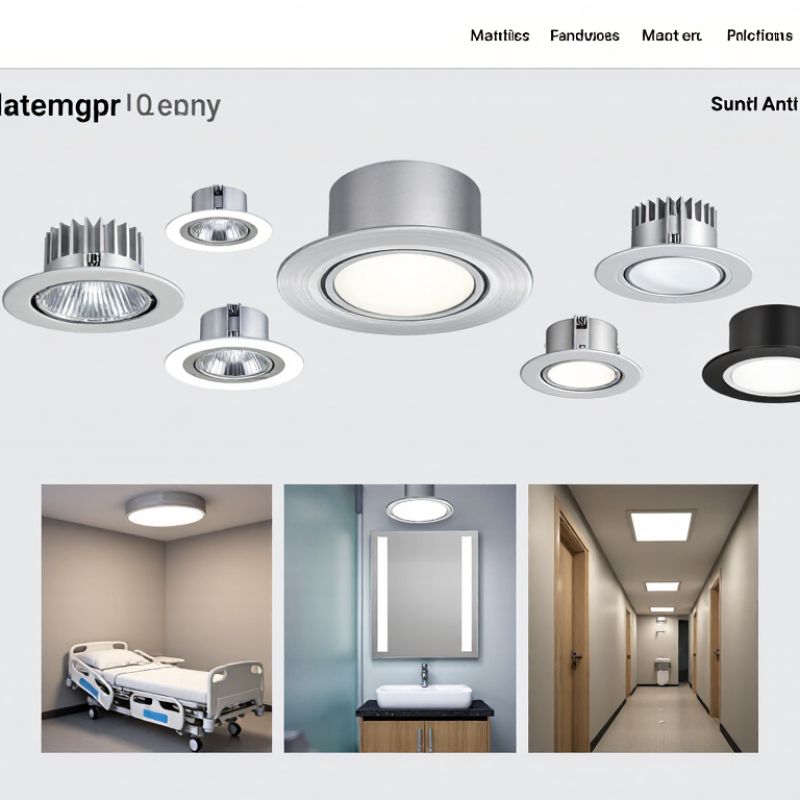
What Anti-Ligature LED Downlights Are and Where They Are Used
Anti-ligature LED downlights are ceiling fixtures designed to reduce accessible points where items could be attached. Their housings sit close to the ceiling, with smooth edges and securely fixed lenses. Some models also use impact-resistant materials. Details vary by product. “Anti-ligature” describes a risk-reduction feature, not a guarantee of complete safety.
These lights may be specified in behavioral health units, secure care facilities, and certain hospital rooms. Common locations include bedrooms, washrooms, corridors, and observation spaces, where exposed fittings can create concerns. A flush profile also helps staff clean surfaces and inspect the ceiling. Not a cure-all. Room layout, furniture, and maintenance still matter.
Good selection balances safety with useful, comfortable light. Check the fitting’s mounting method, cleanability, glare control, and suitability for damp areas. A harsh beam can make a calm room feel clinical; that detail is easy to overlook. Lighting levels should match the task, from night-time checks to reading. Facility teams should review product documentation and assess the full room with qualified design and safety professionals. A downlight alone cannot address every environmental risk.
Key Design and Safety Features of Anti-Ligature Downlights
Anti-ligature downlights are designed to reduce accessible points where cords or other items could be attached. In a behavioral health room, the fitting should sit flush with the ceiling, with smooth edges and minimal gaps around the trim. Small details matter. Recessed screws, secured lenses, and robust housings can make removal or tampering more difficult. Yet no light fitting can remove every risk; room layout, installation quality, and ongoing checks also affect safety.
A lens made from impact-resistant material can help withstand knocks from everyday use. Sealed joints limit dirt buildup and make cleaning more practical, while suitable thermal management helps protect internal components during long operating hours. Light output should support clear visibility without creating harsh glare on pale walls or polished floors. Maintenance access deserves careful thought, too: a fixture that is secure but difficult to inspect may be overlooked. A small design compromise can matter. Teams should confirm that the fitting suits the ceiling construction and the room’s assessed needs, then check fasteners, seals, and operation during routine maintenance. Specs are useful, but the installed detail tells the fuller story.
Key Design and Safety Features of Anti-Ligature Downlights
A qualitative overview of commonly considered design priorities for anti-ligature lighting. Ratings are illustrative, not product test results or manufacturer-specific data.
Anti-ligature lighting should be specified as part of a broader, site-specific safety assessment. Actual performance depends on the luminaire, installation, room conditions, and applicable standards.
Standards and Certifications for Anti-Ligature Lighting in China
China’s anti-ligature lighting checks should separate electrical safety from fixture-level risk. GB 7000.1-2023 covers general luminaire safety and testing, while GB/T 4208-2017 classifies enclosure protection. Neither standard alone certifies a fixture as anti-ligature. That distinction matters. IEC 60529 defines IP6X as dust-tight and IPX4 as protection against splashing water; these ratings do not measure snag resistance. Ask for accredited laboratory reports that identify the tested model, method, and results.
For project review, examine the fitting’s exposed edges, seams, fixings, and resistance to pulling or impact. Specify the test method, load direction, and acceptance criteria; there is no useful shortcut in an IP rating. Check that electrical and ingress tests match the intended room conditions, such as wash-down cleaning or humid air. Confirm whether the product falls within China’s current compulsory certification scope, and request the relevant certificate or written scope assessment. A certificate can support due diligence, but it cannot replace a physical inspection of the installed fitting. Specifications sometimes leave this gap. That deserves a second look.
China Top 10 Anti-Ligature LED Downlight Manufacturers - Standards and Certifications for Anti-Ligature Lighting in China
Brand-neutral standards and compliance reference. This is not a manufacturer ranking or a claim that any particular product is certified. Anti-ligature suitability should be assessed for the specific fixture, installation, and intended environment.
| No. | Evaluation Area | Relevant Chinese Standard or Requirement | What to Verify |
|---|---|---|---|
| 1 | General luminaire safety | GB 7000.1-2015, Luminaires—Part 1: General Requirements and Tests | Request applicable test reports covering electrical safety, construction, insulation, temperature, and marking for the exact luminaire model. |
| 2 | Recessed downlight requirements | GB 7000.202-2008, Luminaires—Part 2-2: Particular Requirements—Recessed Luminaires | Check that the recessed installation type, mounting instructions, clearances, and test configuration match the intended ceiling assembly. |
| 3 | Ingress protection | GB/T 4208-2017, Degrees of Protection Provided by Enclosures (IP Code) | Confirm the tested IP rating is suitable for the specified room and cleaning conditions. An IP rating does not, by itself, establish anti-ligature performance. |
| 4 | Mechanical impact resistance | GB/T 20138-2006, Degrees of Protection Provided by Enclosures for Electrical Equipment Against External Mechanical Impacts (IK Code) | Where impact resistance is specified, verify the IK test level and that the tested cover, trim, fasteners, and mounting arrangement match the supplied product. |
| 5 | Anti-ligature design assessment | Project-specific risk assessment and documented evaluation; do not treat a general luminaire standard as an anti-ligature certification. | Review the installed assembly for accessible gaps, edges, projections, fixing points, and opportunities for attachment. Agree the assessment method and acceptance criteria with the project’s safety and design team. |
| 6 | LED driver and controlgear safety | Applicable luminaire and LED controlgear safety requirements, including the relevant current editions of Chinese GB standards. | Check the driver’s model, electrical ratings, protection features, and test documentation. Confirm that the driver used in production is the one covered by the evidence. |
| 7 | Radio-frequency emissions | GB/T 17743-2017, Limits and Methods of Measurement of Radio Disturbance Characteristics of Electrical Lighting and Similar Equipment | Request applicable EMC emissions results for the luminaire and its driver configuration, including any dimming or control equipment supplied with it. |
| 8 | Electromagnetic immunity | GB/T 18595-2014, Electromagnetic Compatibility—Immunity Requirements for Lighting Equipment | Check the applicable immunity test report and confirm that the tested product configuration is consistent with the installation and control method. |
| 9 | Photobiological safety | GB/T 20145-2006, Photobiological Safety of Lamps and Lamp Systems | Where relevant to the application, request photobiological risk assessment data for the LED light source and finished luminaire. |
| 10 | Market access and certification scope | Check the current China Compulsory Certification (CCC) catalogue and rules for the product category and configuration; a quality-management certificate is not product certification. | Verify whether CCC applies to the specific product, and confirm any certificate covers the exact model and manufacturing site. Check certificate validity and applicable scope with the issuing or regulatory body. |
Standards and certification requirements can change. Confirm current editions, applicability, and project-specific acceptance criteria with the relevant Chinese authorities, accredited testing bodies, and project stakeholders before procurement.
How to Assess China’s Leading Anti-Ligature Downlight Manufacturers
Assessing China’s leading anti-ligature downlight manufacturers means examining safety, not just appearance. Request drawings that show how the trim, lens, and fixings sit against the ceiling. Check for exposed edges, reachable gaps, and parts that could loosen under repeated impact. Small details matter. Ask for independent test reports, the test method, and the exact product configuration tested; a certificate for a similar model is not enough.
Review the optical data too. Compare measured lumen output, beam angle, glare control, colour consistency, and performance after thermal testing. The U.S. Department of Energy’s 2019 forecast for solid-state lighting estimated potential annual U.S. energy savings of 569 terawatt-hours by 2035 against its baseline. That projection concerns lighting broadly, not anti-ligature products, but it underlines why efficacy claims should be verified with test data rather than marketing copy. Request a photometric file and clear test conditions.
Installation and maintenance deserve equal scrutiny. Ask how technicians access the driver without damaging the ceiling, and whether replacement parts remain available. Check warranty terms, lead times, and references from comparable healthcare or custodial projects. A polished sample can hide awkward servicing. No checklist removes judgment: independent reports may not reflect every site condition, so inspect a representative fitting and record unresolved concerns before specifying it.
Profiles of Ten Notable Chinese Anti-Ligature LED Downlight Manufacturers
The ten Chinese manufacturer profiles are most useful as engineering snapshots, not a popularity ranking. Compare each supplier’s experience with behavioral-health projects, custom tooling, sealed housings, and retrofit dimensions. Look closely at the trim: a flush edge, concealed fasteners, and a secure lens can matter as much as light output. Some manufacturers may prioritize stainless-steel construction; others may focus on compact ceilings or project-specific optics. Ask for drawings and test records, not only catalog photographs.
Energy performance still deserves scrutiny. The U.S. Department of Energy’s Energy Saver guidance says LED bulbs use at least 75% less energy and last up to 25 times longer than incandescent lighting. That broad comparison is useful, but it does not prove an anti-ligature fixture is durable or safe for a particular room. Request the exact model’s impact, ingress-protection, thermal, and cleaning-compatibility evidence. Small details matter.
A credible profile should also explain installation limits, replacement access, and how the fixture behaves after repeated cleaning. Ask whether test results cover the complete assembled luminaire, including its lens and mounting hardware. A smooth surface can look reassuring. It is not enough. One weakness in supplier comparisons is that public evidence may be uneven; treat unverified claims cautiously and confirm specifications against project requirements.
Skip to content