What Are the Best Acoustic Panels for 2026?
Choosing the best Acoustic Panels for 2026 is less about chasing a top-rated product and more about matching treatment to the room. A home office with sharp video-call echoes needs different coverage than a music room with flutter between bare walls. Even a few panels can help, when they are placed thoughtfully. More is not always better.
Sound expert Julian Treasure has said, “We are losing our listening.” His point reaches beyond panels: room sound shapes how clearly we hear voices, music, and everyday details. Acoustic panels absorb some sound energy, reducing reflections; they do not block all outside noise or fix every acoustic problem. That distinction matters.
This guide compares panel types, materials, thicknesses, finishes, and practical installation choices. It also considers published absorption ratings, while noting that results depend on placement and room conditions. A fabric-wrapped panel may suit a meeting space, while a wood-slat design can balance absorption with a more finished look. Check the dimensions against your wall, and look for clear product specifications rather than broad promises. Small details count.
There is no single winner for every room. A panel that looks elegant in a showroom may disappoint above a desk or behind a microphone. Measurements help, but they cannot replace listening in the actual space. This guide aims to make the trade-offs visible, though no shortlist can predict every room’s quirks.
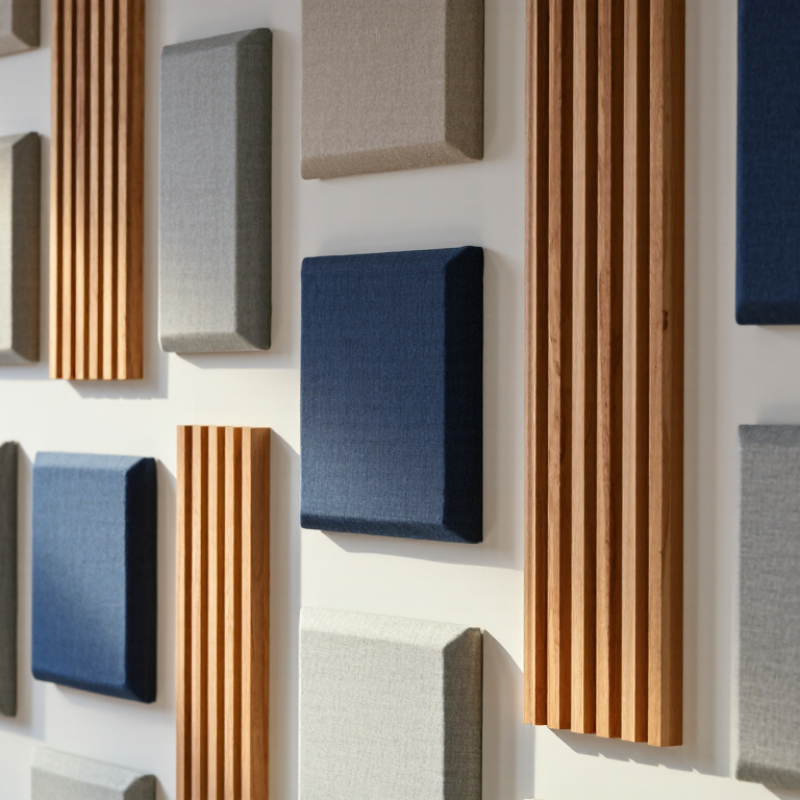
How Acoustic Panels Work and Where They Are Used
Acoustic panels improve how a room sounds by absorbing some sound energy, especially mid- and high-frequency reflections. Many use porous materials, such as mineral fiber or dense foam, behind a fabric or perforated surface. Sound passes into the material, where friction converts a portion of its energy into heat. The result can be clearer speech and less fluttering echo, not silence. That distinction matters. Panels do not usually stop noise traveling through walls; that requires different construction and sealing. Panel thickness, material, and the air gap behind a panel all affect its performance, so appearance alone is a poor guide.
Panels are useful in home offices, classrooms, meeting rooms, music practice spaces, and restaurants where hard surfaces make voices blur together. In a small office, a few panels near reflective walls may help video calls sound less hollow. Small rooms reveal it. Placement should respond to the actual problem: listen for sharp echoes, then treat key reflection points on walls or ceilings. Covering every surface can make a room feel unnaturally dull, while leaving the ceiling untreated may preserve distracting reflections. Results depend on the room, furnishings, and panel specifications. A practical approach is to add a modest amount, listen again, and adjust; even careful placement can miss an awkward corner or an unexpected source of echo.
Which Panel Types and Materials Are Available in 2026?
In 2026, common acoustic panel choices include fabric-wrapped absorbers, PET felt panels, perforated wood panels, and foam tiles. Broadband panels reduce mid- and high-frequency reflections in rooms such as offices, studios, and home theaters. Bass traps are thicker, often placed in corners to help control low-frequency buildup. Diffusers scatter sound rather than absorb as much of it. Placement matters.
Materials affect performance, appearance, upkeep, and installation. Mineral wool and fiberglass are widely used porous cores, usually enclosed behind fabric. PET felt is lighter and can be cut into decorative shapes. Wood-slat panels often combine a hard surface with absorbent backing, balancing room reflections and a natural look. Foam is lightweight, but thin tiles may do little for bass; appearance alone is not a reliable performance measure. Check published absorption data, panel thickness, mounting method, and relevant fire-safety information before choosing. Results depend on the room, and a small test installation can prevent an expensive mismatch.
Tips: Clap from different spots and listen for sharp echoes. Treat reflection points before covering every wall. Leave some surfaces untreated; an overly damped room can sound lifeless. If speech remains muddy, thicker panels or corner treatment may help, though moving furniture can also change the result.
How to Evaluate Acoustic Panel Performance and Quality
What Are the Best Acoustic Panels for 2026?
Evaluate panels by measured performance, not appearance alone. ASTM C423-23 measures sound absorption in a reverberation room. The Noise Reduction Coefficient (NRC) averages absorption results at 250, 500, 1,000, and 2,000 Hz, rounded to the nearest 0.05. An NRC of 0.80 suggests strong average absorption across those frequencies, but it does not describe every sound. Low bass, speech clarity, and room echo can behave differently. Numbers help. Ask for the full frequency-by-frequency test data, not just one rating.
Check how the test setup compares with your room. ISO 354 also describes reverberation-room testing, while ISO 3382-2 covers measuring reverberation time in ordinary rooms. A panel’s thickness, air gap, mounting method, and placement can affect results. A thin panel may calm sharp handclaps yet do little for a deep HVAC rumble. That is a useful blind spot to remember: lab results are not a promise of identical room performance. Look for the test standard, sample size, mounting details, and report date.
Tips: Before buying, record a short clap test from the room’s main listening position, then note the echo and problem areas. Compare that observation with published absorption data at the frequencies you care about. Check installation details and durability, too. I would not choose by NRC alone; it is convenient, but incomplete.
What Are the Best Acoustic Panels for 2026? – How to Evaluate Acoustic Panel Performance and Quality
Compare panel types by their typical acoustic behavior and check the test report for the exact product, thickness, air gap, and mounting method. Values below are general guidance, not guaranteed product ratings.
| Panel Type | Typical Sound Absorption | Best Use | Key Performance Checks | Quality and Safety Considerations |
|---|---|---|---|---|
| Fabric-wrapped mineral wool or fiberglass | Often achieves a high NRC, commonly around 0.80–1.00 in tested configurations. Performance depends on thickness, density, facing, and mounting. | Reducing reflections and reverberation in studios, offices, classrooms, and meeting rooms. | Request an ASTM C423 or ISO 354 laboratory report. Check the tested thickness and whether the panel was mounted with an air gap. | Review the panel’s fire-test documentation, edge protection, fabric durability, and installation hardware. Avoid assuming that the core’s properties apply to the complete panel. |
| PET felt panels | Ranges widely with thickness and design; thin decorative sheets may absorb substantially less than thicker panels or assemblies with an air gap. | Lightweight wall treatments, shared work areas, and spaces where low weight or a firm surface is useful. | Compare laboratory absorption data at individual frequencies, not just a single summary rating. Confirm that the tested construction matches the panel being considered. | Check recycled-content claims, material composition, cleanability, flame-test results, and whether the edges remain stable during normal use. |
| Acoustic foam | Typically more effective at mid and high frequencies than at low frequencies; performance depends strongly on thickness, profile, and mounting. | Controlling high-frequency reflections in suitable, appropriately protected indoor applications. | Look for independent test results for the exact foam shape and thickness. A textured or wedge profile alone does not establish acoustic performance. | Check fire classification, smoke-related documentation where relevant, and suitability for the room. Do not cover required vents, sprinklers, or exits. |
| Perforated or slatted wood absorber | Absorption depends on the perforation or slot pattern, cavity depth, backing material, and any porous infill; there is no single rating for all designs. | Rooms needing sound control alongside a hard, architectural finish. | Ask for test data for the full assembly, including backing and cavity. Check frequency-by-frequency results for the room’s needs. | Inspect veneer or finish quality, panel alignment, mounting details, and fire documentation for the complete assembly. |
| Ceiling clouds and suspended baffles | Can provide substantial absorption because both faces may be exposed; results depend on panel area, spacing, and suspension height. | Open offices, classrooms, dining areas, and rooms with reflective ceilings. | Confirm the test configuration and exposed surface area. For suspended products, compare absorption per unit area using equivalent test information. | Check load limits, suspension hardware, seismic or local code requirements where applicable, and clearance from lights and building services. |
| Any panel: rating and test report | NRC is a rounded, single-number rating based on absorption at 250, 500, 1,000, and 2,000 Hz. It does not describe performance at every frequency. | Shortlisting products, followed by checking whether their measured performance suits the room. | Prefer a report from an independent laboratory using ASTM C423 or ISO 354. Compare octave-band data and the exact mounting conditions. | Check the report date, tested product identification, thickness, mounting, and any stated limitations. Treat marketing claims without supporting test details cautiously. |
| Any panel: room fit and installation | Panels reduce reflected sound and reverberation; they do not block sound transmission through walls or make a room soundproof. | Choosing coverage and placement after identifying the room’s main reflection and reverberation problems. | Consider room size, surface coverage, ceiling height, furnishings, and the target use. A qualified acoustic assessment can help where speech intelligibility or critical listening matters. | Use suitable fixings for the substrate and follow the manufacturer’s installation instructions. Keep panels clear of safety equipment and maintainable building systems. |
NRC is a rounded rating and can conceal differences between frequency bands. Published absorption results are not directly comparable unless the test method, specimen, mounting, and reported metric are also comparable.
Which Acoustic Panels Suit Different Rooms and Budgets?
A small home office rarely needs full-wall coverage. Start with a few fabric-wrapped panels at ear height, especially behind a desk or opposite a hard wall. For tighter budgets, thick curtains and a filled bookcase can soften reflections, though they are not substitutes for tested acoustic panels. In a shared office, panels with published absorption data are a safer choice than judging by appearance alone.
Check the Noise Reduction Coefficient (NRC), measured under ASTM C423. It averages absorption across four frequencies, so one number does not tell the whole story. For speech-heavy rooms, panels with an NRC near 0.80 or higher can be a useful starting point, but placement and room size still matter. Classrooms need closer attention: ANSI/ASA S12.60 sets reverberation-time limits, including 0.6 seconds for certain smaller classrooms. That is a room target, not a promise from any single panel.
Dining rooms and living rooms usually benefit from selective coverage that leaves some hard surfaces, avoiding a dull, lifeless sound. Studios and noisy meeting rooms may need thicker panels, ceiling clouds, or bass traps; thin decorative tiles often miss low-frequency buildup. Measure before buying. Even a phone recording can reveal an obvious echo, but it cannot replace professional room testing. A little guesswork remains. Check fire-performance documentation and installation instructions, too, especially in public spaces.
What Are the Best Acoustic Panels for 2026?
Typical sound absorption by panel type, with options for different budgets and room needs.
How to read this chart: NRC (Noise Reduction Coefficient) is a standardized estimate of how much sound a material absorbs, on a scale from 0 to 1. Values shown are representative examples, not guarantees; exact performance depends on the specific panel, thickness, mounting, and test results. Budget foam can help reduce reflections in small rooms, while thicker fiber panels are often a stronger choice for studios, offices, and larger spaces. NRC does not describe low-frequency performance, which may require thicker panels or bass traps.
How to Choose, Place, and Maintain Acoustic Panels
Choosing acoustic panels starts with identifying the problem. Echo during calls, harsh reflections, and rumbling bass need different solutions. Start with the problem. For speech and music clarity, porous panels made from mineral fiber or dense recycled material can absorb mid- and high-frequency sound. Thicker panels, or panels mounted with an air gap, can help absorb lower frequencies. Check the panel’s tested absorption data, not just its appearance. Panels reduce reflections; they do not soundproof a room or block outside noise.
Placement matters as much as material. Sit or stand where you usually listen, then ask someone to move a small mirror along the side walls. Where you can see a speaker in the mirror is a useful spot for a panel. Consider the opposite wall and ceiling too, especially in a bare room with hard floors. Leave space around panels if possible, and avoid covering vents or lights. A few well-placed panels often work better than covering every wall. Still, the mirror method is only a starting point, not a perfect acoustic plan.
Keep panels clean with gentle vacuuming and a soft brush, following the maker’s care instructions. Some fabrics stain easily, and moisture can damage certain cores. Check fixings occasionally, especially after moving furniture. Then listen again. If voices sound unnaturally dull, the room may be over-treated; remove or reposition a panel and compare. Small adjustments count.
Skip to content